How to Break 100 in Golf: A Practical Plan for New Golfers

Breaking 100 in golf requires shifting your focus from hitting perfect shots to eliminating blow-up holes and managing your expectations. According to the National Golf Foundation, only 55% of adult golfers routinely break 100, making it a significant milestone for beginners and recreational players. This guide outlines the strategic adjustments, course management techniques, and practice priorities you need to consistently shoot in the 90s.
What Does a Sub-100 Scorecard Actually Look Like?
The first step to breaking 100 is understanding the math. Many golfers fail because they believe they need to hit greens in regulation and sink long putts to reach their goal. In reality, shooting in the 90s is about limiting damage rather than playing flawless golf.
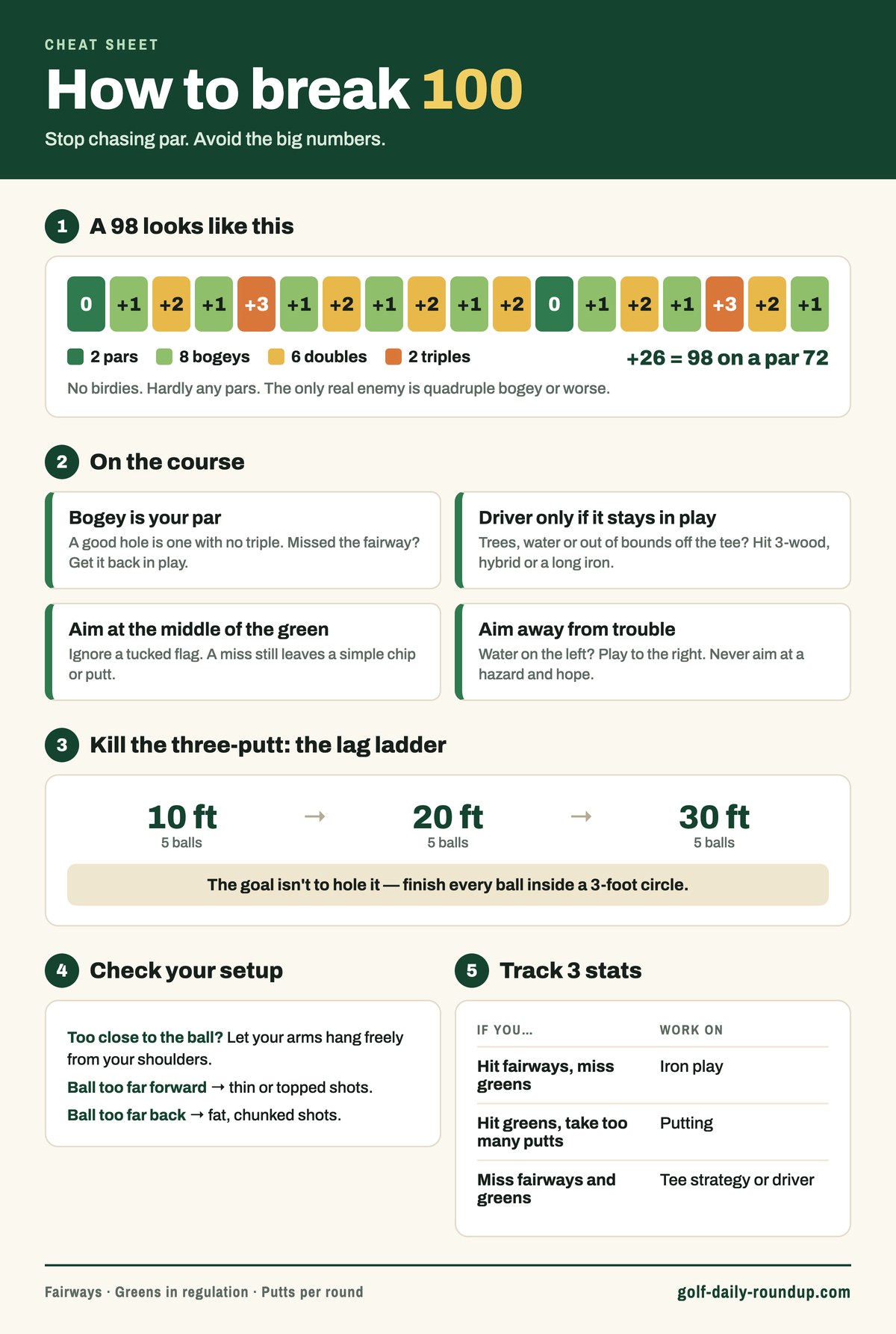
If we use a score of 98 as our target, a realistic and achievable scorecard looks like this: 2 pars, 8 bogeys, 6 double bogeys, and 2 triple bogeys.
While this does not look like a spectacular round of golf, it successfully breaks the 100 barrier. The key takeaway is that you do not need to make par on every hole. There is no style column on the scorecard. By accepting that bogeys and double bogeys are part of the process, you remove the pressure that leads to erratic, high-risk shots. Your primary objective becomes avoiding nuclear blow-up holes where you score a quadruple bogey or worse.
How Do You Manage Expectations and Ignore Par?

Watching professional golf on television often warps a recreational player’s expectations. Pros make birdies and pars look effortless, leading amateurs to chase a score that is entirely unreasonable for their current ability level. To break 100, you must leave this mentality behind and adopt a simpler goal: as one instructor notes, "You’re not trying to make par, you’re simply trying to avoid making big numbers".
This means redefining success on the course. Instead of being disappointed by a bogey, you should embrace it.
"Bogey is my friend. Repeat it again…bogey is my friend." — Practical Golf
When you accept that bogey is your target, a successful hole is one where you avoid a triple bogey. If you hit an errant tee shot, your goal shifts from trying to heroically recover and make par to simply getting the ball back in play and securing a bogey or double bogey. This mental shift prevents the frustration that causes golfers to rush their swings and compound their mistakes.
What Are the Most Effective On-Course Strategies?
Executing a sub-100 round requires disciplined course management. You must play to your strengths and actively avoid situations that expose your weaknesses.
- Limit Your Driver: If your driver frequently finds the trees, water, or out-of-bounds, leave it in the bag. Hitting a 3-wood, hybrid, or even a long iron off the tee keeps the ball in play and prevents the dreaded penalty strokes that lead to blow-up holes.
- Ignore the Pin: When approaching the green, do not aim directly at a tucked flag position. Aim for the center of the green. This gives you a larger margin for error and ensures that even a poorly struck shot leaves you with a manageable chip or putt.
- Play Away from Hazards: When planning your shots, “plan your shots around the course in a way that avoids trouble”. If there is water on the left side of the fairway, aim for the right side. Never aim at a hazard and hope you don’t hit it into it.
The mental barrier to breaking 100 is often higher than the physical one. As one golf coach explains, "You’ve just got to be smarter than the barrier and stop shooting yourself in the foot". Smart, conservative play will yield a much lower score than aggressive, high-risk play.
How Can You Master Distance Control and the Two-Putt?

The short game is where high handicappers lose the most strokes. You do not need to hole every chip or sink every putt to break 100, but you must master the two-putt. Three-putting is a primary reason golfers remain stuck in the 100s.
To improve your putting, focus on distance control rather than just stroke mechanics. Most golfers think putting is purely about the length of the stroke, but “timing, tempo, and face control matter just as much”.
Practical Drill: The Lag Putting Ladder
Set up three tees at 10, 20, and 30 feet from the hole. Putt five balls from each distance. Your goal is not to make the putt, but to leave every ball within a three-foot circle around the hole. This drill builds the feel and tempo required to ensure your first putt is always a makable second putt, effectively eliminating three-putts from your scorecard.
Why Do High Handicappers Lose Strokes on Full Shots?
When full shots go wrong, it is rarely because the swing itself is fundamentally broken; it is usually because the setup is flawed. A poor setup wastes a perfectly good swing and leads to inconsistent contact.
One of the most common mistakes is “standing far too close to the ball”. When you stand too close, your arms are cramped at impact, leading to blocked shots to the right or inconsistent strikes. Ensure you have enough space to let your arms hang freely from your shoulders.
Additionally, incorrect ball position will ruin your contact. If the ball is too far forward, you will hit it thin or top it. If it is too far back, you will chunk it or hit it fat. Take the time at the practice range to map out exactly where the ball should be positioned for every club in your bag, and replicate that setup on the course.
How Should You Track Your Progress to Identify Weaknesses?

As the founder of Golf Daily RoundUp and a developer of golf scoring and handicap software, I often see players improve fastest when they transition from guessing to tracking. To break 100, you need to know exactly which part of your game is holding you back.
Golf breaks down into three primary stats: fairways hit, greens in regulation, and putts per round. By tracking these three metrics over several rounds, you can identify your specific leak.
- If you hit fairways but miss greens, your iron play needs work.
- If you hit greens but take too many putts, you need to spend more time on the practice putting green.
- If you miss fairways and subsequently miss greens, your tee strategy or driver mechanics need adjustment.
Using a simple notebook or a golf app to record these stats after every round removes the guesswork from your practice sessions. It allows you to dedicate your limited practice time to the exact skill that will lower your score the most, rather than just mindlessly hitting balls at the driving range.
Frequently asked questions
What is the easiest way to break 100 in golf?
The easiest way to break 100 is to eliminate triple bogeys and worse by playing conservatively. Accept bogeys as your target score, limit the use of your driver if it causes trouble, and aim for the center of the greens rather than attacking difficult pin positions.
How long does it usually take to break 100 in golf?
The timeline varies based on how often you play and practice, but it can happen relatively quickly with focused effort. Some golfers who apply strict course management and fundamental fixes have broke 100 for the first time after about 8 or 9 weeks of playing once a week.
What handicap is needed to break 100 in golf?
While the exact handicap index varies by course difficulty, breaking 100 is the standard milestone for high-handicap golfers. Achieving this score typically aligns with lowering your handicap to the mid-20s, establishing a baseline for future improvement toward breaking 90.
Is breaking 100 in golf hard?
Yes, it is a significant challenge, as only about half of all adult golfers achieve it routinely. It requires mental discipline, strategic course management, and consistent practice, but it is entirely attainable for any player willing to adjust their expectations and play smart.
Reviewed by Shahid Anwer · Editorial standards