Golf Scoring Formats Explained: Stroke Play, Match Play, and Stableford

Golf scoring formats determine how a winner is decided, with stroke play counting total strokes, match play deciding hole-by-hole winners, and Stableford awarding points based on performance relative to par. This guide breaks down the mechanics, strategic nuances, and practical applications of the three primary golf scoring formats used in amateur and professional competition.
How Does Stroke Play Determine the Winner?
Stroke play, frequently referred to as medal play, is the most traditional and widely recognized method of keeping score in golf. In this format, the objective is straightforward: complete the designated number of holes in the fewest total strokes. As noted in historical records of the game’s variations, in stroke play, the score is derived by “counting the total number of strokes taken” over one or more rounds.
Because every single stroke is added to a cumulative total, this format rigorously tests a golfer’s ability to manage mistakes. Fairlawn Golf highlights that stroke play is revered for its simplicity and fairness, as it “rewards consistent play over the entire course”. A brilliant birdie on the fourth hole does not erase the damage of a triple bogey on the seventh. This mathematical reality forces players to prioritize course management, hazard avoidance, and steady recovery shots over high-risk hero plays.
Stroke play is the standard format for professional majors, including The Masters, the U.S. Open, The Open Championship, and the PGA Championship. It is also the baseline format for establishing and maintaining an official golf handicap. While it provides the purest test of overall skill, the cumulative nature of the scoring can be mentally punishing for beginners and high-handicap recreational players who may feel their round is ruined by a single disastrous hole.
What Makes Match Play a Hole-by-Hole Battle?
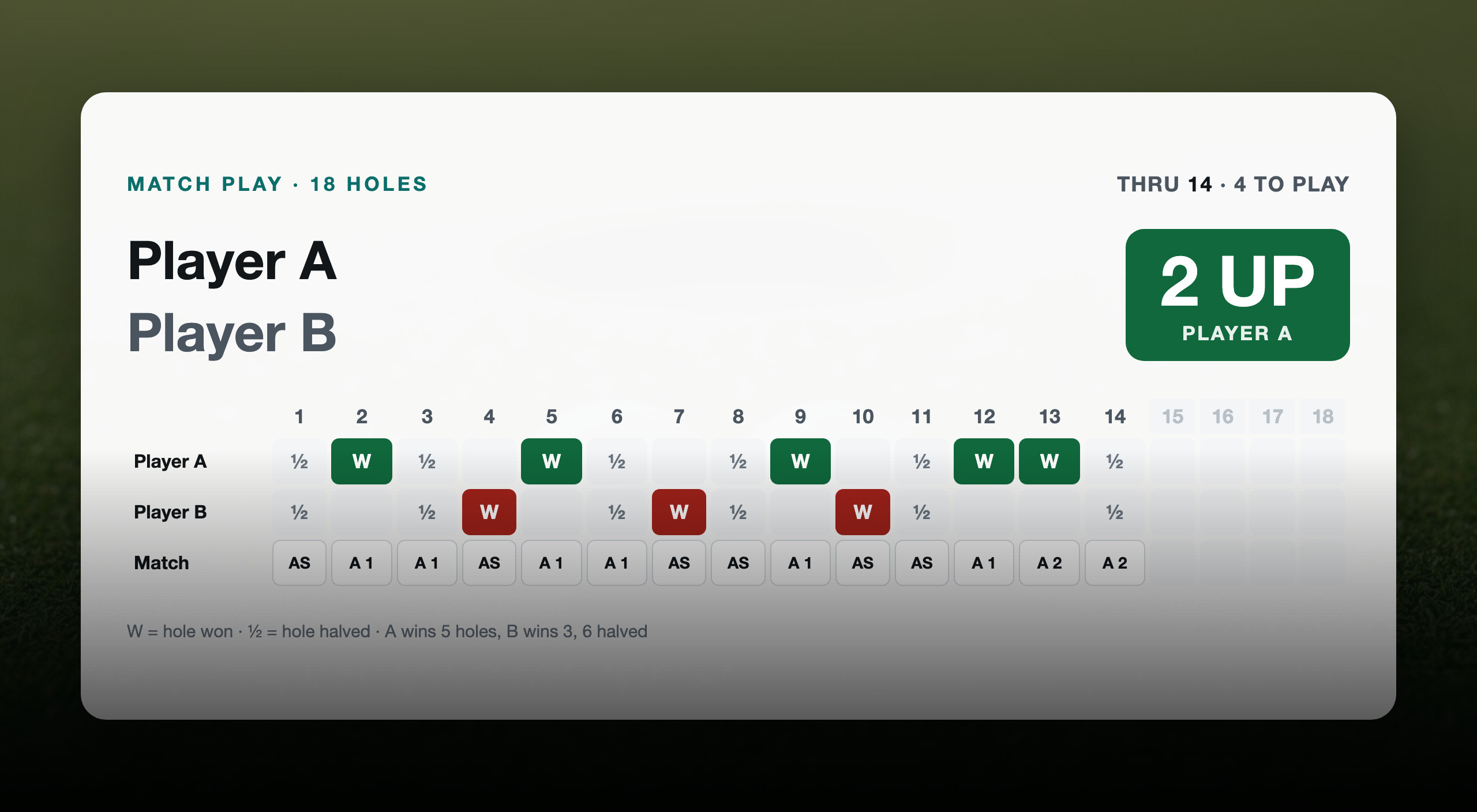
Match play shifts the focus from the total score to head-to-head competition. As explained by MyGolfSpy, in match play, you “compete against another player on a hole-by-hole basis”. The player who completes a hole in the fewest strokes wins that specific hole. If both players take the same number of strokes, the hole is halved (tied). The overall match is won by the player who wins the most holes.
This format completely changes the strategic landscape of the game. Because the total number of strokes does not matter, a massive score on a single hole only costs you one hole in the match, regardless of whether you lose it by one stroke or five. This encourages much more aggressive and strategic play, as you focus on winning individual holes rather than minimizing your overall stroke count. If you are down by three holes with only three to play, you must play aggressively to win those remaining holes; conservative play will guarantee a loss.
Match play features its own unique scoring terminology. For example, winning a match "5&4" signifies that one player is five holes ahead with only four holes remaining, making it impossible for the opponent to recover. Additionally, the term "dormie" is used to refer to the situation where the number of holes remaining is equal to the leading player’s lead. Match play is the foundation of team events like the Ryder Cup and is highly popular in club-level competitions because it allows players of varying skill levels to compete closely when handicaps are applied.
How Are Points Calculated in Stableford?

Stableford is a highly popular alternative to traditional stroke play that rewards good play while mitigating the damage of bad holes. In Stableford play, players are awarded points for each hole based on their score relative to a fixed target, which is usually the hole’s par. Unlike most scoring systems in golf, the player with the most points wins the game.
When playing off a handicap, the fixed score is adjusted. For instance, if you receive a handicap stroke on a specific hole, your target score for that hole becomes a bogey rather than a par. The standard Rules of Golf points system, as detailed by Golfbreaks, allocates points as follows:
| Score Relative to Fixed Score | Points Awarded |
|---|---|
| More than 1 over fixed score | 0 points |
| 1 over fixed score (Bogey) | 1 point |
| Fixed score (Par) | 2 points |
| 1 under fixed score (Birdie) | 3 points |
| 2 under fixed score (Eagle) | 4 points |
| 3 under fixed score (Albatross) | 5 points |
| 4 under fixed score (Condor) | 6 points |
The most significant practical advantage of this system is pace of play and psychological relief. If a player takes more than one stroke over their fixed net score (meaning they would earn zero points), they do not need to complete the hole. They can simply pick up their ball, record a zero, and move on. This prevents slow play caused by players trying to salvage a hopelessly lost hole and keeps the overall mood of the round positive.
Which Scoring Format Should You Choose for Your Game?

As someone who builds golf scoring and handicap software, I analyze how different formats impact both course management and user experience. The choice of format should align with the goals of the competition or the casual round.
- For pure skill assessment: Stroke play remains the gold standard. It leaves nowhere to hide and accurately reflects a player’s total ability to navigate a course over 18 holes. However, software and scorekeepers must ensure all holes are completed, which can slow down the final groups in a tournament.
- For head-to-head rivalry: Match play is unparalleled. It creates intense, localized drama on every single hole. When organizing match play, ensure the handicap software correctly allocates strokes based on the stroke index of each hole, as receiving a stroke on a difficult par 4 changes the dynamic entirely compared to receiving it on an easy par 3.
- For enjoyment and pace: Stableford is the ultimate format for amateur and recreational golf. By capping the maximum score on any hole at zero points, it eliminates the "snowman" (shooting an 8 or worse) that typically ruins a beginner’s confidence. It is also the preferred format for amateur pro-am events and charity tournaments.
It is also worth noting that variations like Par and Bogey competitions operate similarly to match play, but the player competes against the course rather than an opponent. Each hole is scored as a win, half, or loss versus the fixed par score, combining the hole-by-hole drama of match play with the individual focus of stroke play.
Practical Takeaway for Tournament Organizers
When selecting a format for your next club event or group outing, use this quick checklist:
- Choose Stroke Play if you want a strict, traditional test of consistency and have a strict time limit for the entire field.
- Choose Match Play if you want to foster direct competition, team camaraderie, and dramatic finishes, ensuring you have a clear method for resolving ties (such as a sudden-death playoff).
- Choose Stableford if your primary goals are maintaining a fast pace of play, keeping high-handicappers engaged, and ensuring everyone finishes the round with a positive score.
Whichever format you pick, the scoring and the handicaps have to be right on the day. For live scoring, LiveGolfScoring handles stroke play, match play, Stableford and team formats, with a public leaderboard players can follow from their phones. For groups that keep their own handicaps, Golf Handicap Management applies WHS or CONGU rules, so the strokes each player receives in a net or match play event come from an up-to-date index.
Disclosure: LiveGolfScoring and Golf Handicap Management are built by the team behind Golf Daily RoundUp.
Frequently asked questions
What are the different scoring formats in golf?
The three primary official golf scoring formats recognized by the USGA and R&A are stroke play (counting total strokes), match play (winning individual holes head-to-head), and Stableford (awarding points based on scores relative to par). Other official variations include Par/Bogey competitions and maximum score formats.
What does 69 mean in golf?
Shooting a 69 means completing an 18-hole round in exactly 69 strokes. On a standard par-72 course, this represents a score of 3-under-par, which is a highly respected benchmark indicating excellent play for both amateur competitors and professional tour players.