How to Build a Golf Practice Plan That Actually Lowers Your Scores

A successful golf practice plan divides time based on where strokes are lost, prioritizing short-game variability over repetitive full-swing mechanics. By shifting from block practice to random, game-like scenarios, amateurs can translate range improvements directly to the course. This guide breaks down the science of motor learning, strokes-gained data, and structured time blocks to help you practice with purpose.
Why Traditional Range Sessions Fail to Lower Scores
Most amateurs arrive at the driving range, grab a bucket of balls, and hit the same club to the same target repeatedly. According to an ultimate golf improvement plan by Mike Foy, 99% of people at the range are not learning or developing skill, but rather living in their comfort zone.
Hitting 7-irons without a specific objective does not prepare you for the varied lies, wind conditions, and pressure situations encountered on the course. Real growth requires stepping outside this comfort zone and embracing awkward, uncomfortable repetitions that build actual course readiness.
Block vs. Random Practice: What the Science Says
Motor learning research clearly distinguishes between two primary methods of repetition. Block practice involves repeating the exact same movement over and over, such as hitting 10 putts from the exact same spot. Random practice randomizes reps so you never do the exact same thing twice. As explained by motor learning experts, "Transfer is the word motor learning scientists use to describe real learning". During random practice, you are forced to read, plan, and execute before every single rep, which eliminates the autopilot mode of block practice.
This concept is rooted in the variability of practice hypothesis, which proposes that variable practice leads to superior motor control compared to constant practice. By manipulating between-skill variability (switching from chipping to putting to driving) and within-skill variability (hitting from flat, downhill, and uphill lies), you build a robust skill set that holds up under pressure.
What Golf Researchers and Top Coaches Recommend
The most detailed study of how amateurs should practice was run at Pinehurst Resort. Golf instructor Eric Alpenfels and Dr. Bob Christina, professor emeritus of kinesiology at the University of North Carolina at Greensboro, tested practice methods on golfers of different skill levels and published the results in their book Evidence-Based Golf. Their central finding: "Practicing like you play has high transfer back to the practice area and play on the golf course."
They turn that idea into specific range habits:
- Play simulated holes. Picture a real hole, pick a target, mark out the fairway or green in your mind, and play it with no mulligans.
- Change clubs and targets. Hit to different targets with randomly chosen clubs, or keep one club and change the distance, for example a 7-iron to 140, 150 and 160 yards.
- Hit one ball, not a pile. In the short-game area, play one ball per shot and move on after a bad one, as you must on the course.
- Use your full routine on every shot, so it feels natural when it counts.
- Practice trouble shots, such as punching under branches or splashing out of a plugged lie.
- Finish with up-and-downs: chip, then hole the putt that follows.
The short game deserves its place because of how often you use it. Dave Pelz, a former NASA physicist who became the game’s best-known short-game coach and taught major winners including Phil Mickelson and Vijay Singh, found from years of tracking rounds that more than 60% of golf shots are played from within about 100 yards of the hole.
How to Allocate Time Based on Strokes Gained Data

AI illustration · Golf Daily RoundUp
To build an effective golf practice plan, you must allocate time to the areas that yield the highest return on investment. The strokes-gained method, popularized by Mark Broadie in Every Shot Counts, allows golfers to accurately pinpoint weaknesses in driving, approach shots, short game, and putting. Traditional stats like fairways hit or putts per round often provide a misleading indication of where you actually lose strokes.
Broadie’s own numbers show why a plan cannot skip the long game. Comparing a typical golfer who shoots 90 with one who shoots 80, he found that about six and a half of those 10 strokes come from better shots outside 100 yards, and about three and a half from shots inside 100 yards.
That fits with Pelz’s finding rather than contradicting it. Most of your shots happen near the green, so short-game work touches the most strokes and pays off quickly; as a Practical Golf guide puts it, "working on your game from inside 100 yards is the quickest way to lower your scores". But most of the gap to the next level comes from approach and tee shots, so a plan that drops the full swing caps how far you can improve. The time splits below give the short game the first and biggest share without abandoning the long game.
The 20/20/20 Method: A 60-Minute Golf Practice Plan
If you have an hour to practice, dividing your time into three 20-minute segments ensures comprehensive coverage without neglecting the short game.
- Segment 1: Chipping and Putting (20 Minutes). Start with the most critical scoring areas. Focus on chipping around the green to develop low-point control, followed by putts inside 10 feet to build speed control and start-line accuracy.
- Segment 2: Wedge Play (20 Minutes). Move to your wedges (pitching, gap, sand, lob). Instead of hitting full swings, practice partial swings to control distance. Pick specific landing spots and own three distinct distances with each wedge.
- Segment 3: Full Swings (20 Minutes). Finish with your longer clubs. Hit fewer balls with more intention. Take a full reset between shots, checking your grip, alignment, and posture, and visualize a specific target on the course.
A 30-Minute Golf Practice Plan for Busy Amateurs

AI illustration · Golf Daily RoundUp
When time is limited, maintaining the correct ratio is more important than the total volume of balls struck. You can scale the 20/20/20 method down to a 10/10/10 structure.
- First 10 Minutes: Putting and chipping. Make 10 putts from 3 feet, then chip 10 balls to a specific target, focusing on consistent contact.
- Second 10 Minutes: Wedge distance control. Hit 10 partial wedge shots, alternating between 30, 40, and 50 yards.
- Final 10 Minutes: Full swings. Hit 10 shots with your driver or longest iron, focusing entirely on a balanced finish and center contact rather than maximum distance. An optimized 1-hour session follows this exact 20-minute triad, proving the ratio works regardless of the total time available.
A Weekly Schedule for Mastering Putting, Chipping and Shots Inside 100 Yards
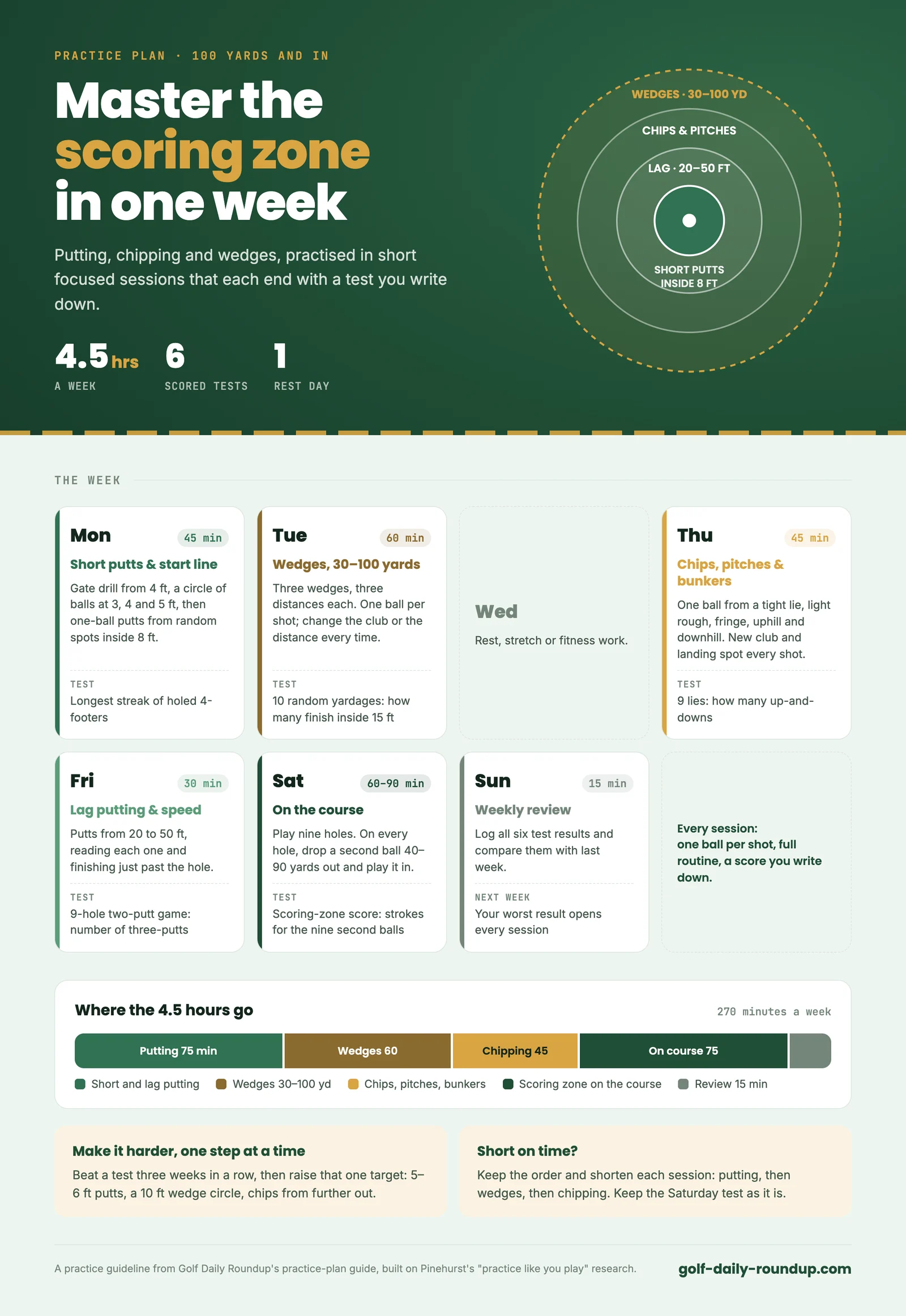
A golfer who wants to master the scoring zone can do it in about four and a half hours a week: four focused practice sessions, one on-course session and a short weekly review. Each session works on one skill, uses varied, game-like reps, and ends with a scored test you write down.
| Day | Focus | What to do | End with this test |
|---|---|---|---|
| Monday (45 min) | Short putts and start line | 15 min of the gate drill from 4 feet; 15 min around a circle of six balls at 3, 4 and 5 feet; 15 min of one-ball putts from random spots inside 8 feet, with your full routine | Longest streak of holed putts from 4 feet |
| Tuesday (60 min) | Wedges from 30 to 100 yards | Choose three wedges and three distances for each; hit one ball per shot and change the club or the distance every time; finish with shots to yardages you pick at random | 10 balls to random yardages: how many stop within a 15-foot circle |
| Wednesday | Rest | Rest, stretch, or fitness work | — |
| Thursday (45 min) | Chipping, pitching and bunkers | One ball at a time from a tight lie, light rough, the fringe, uphill and downhill, changing landing spot and club every shot; 10 minutes of greenside bunker shots if you can | Nine balls from nine different lies: how many you get up and down |
| Friday (30 min) | Lag putting and speed | Putts from 20 to 50 feet, using the speed drills and green reading to finish each putt just past the hole | The 9-hole two-putt game below: number of three-putts |
| Saturday (60–90 min) | On the course | Play nine holes. On every hole, drop a second ball somewhere between 40 and 90 yards from the green and play it into the hole | Your "scoring zone score": total strokes for the nine second balls |
| Sunday (15 min) | Weekly review | Write this week’s six test results in your log and compare them with last week | Pick the worst result; it becomes the first 15 minutes of every session next week |
How to progress. When you beat a test three weeks in a row, make it harder: move the short putts out to 5 or 6 feet, shrink the wedge circle to 10 feet, or take the chipping lies further from the green. Change one target at a time so you can see which change is working.
If you have less time, keep the order and shorten the sessions: putting, then wedges, then chipping, with the Saturday test kept as it is. The weekly test matters more than the total hours, because it tells you whether the practice is reaching the course.
How to Test Yourself with Scoring Practice Games
Practice must include a competitive element to simulate tournament pressure. According to the ultimate golf improvement plan, 10% to 20% of your dedicated practice time should be spent testing yourself with games that have a definitive pass or fail score.
- The 9-Hole 2-Putt Game: As outlined in a one-week junior practice routine from PGA coach Chris Smeal, pick nine putts outside of 20 feet. Your goal is to two-putt all nine "holes." If you three-putt, you lose the hole.
- The Up-and-Down Challenge: Drop three balls around a practice green in different lies (tight lie, light rough, fringe). Chip the first ball to within a 3-foot circle, then make the putt. You must successfully get up and down for all three balls to pass the drill.
How US College Golf Teams Structure a Practice Week
US college golfers practice within NCAA limits: during the season a team can require no more than 20 hours of athletic activity a week and 4 hours a day, with at least one day off, and only 8 hours a week out of season. Inside those limits, a typical week mixes early-morning workouts, coached practice, extra individual work and 18-hole rounds.
One former NCAA Division I player’s typical week looked like this:
| Day | Morning | Afternoon and evening |
|---|---|---|
| Monday and Wednesday | Workout 6–7am, team practice 8–11:30am | Classes, then about an hour of individual practice |
| Tuesday and Thursday | Workout 6–7am, classes | Team practice 1–3:30pm, then extra practice or a quick nine |
| Friday | Team yoga | 18 holes with the team |
| Saturday | 18 holes and extra practice | Free |
| Sunday | Required day off | Optional practice |
What makes college practice different is that it is scored. Teams usually pick their tournament lineup through qualifying rounds: at Oklahoma, for example, the winner of each qualifier earns a spot, and other places go to the cumulative leaders or to a coach’s pick. Every qualifying round is a test with something at stake, which is exactly what most amateur practice lacks.
College players are not ranked by handicap. They are measured by scoring average and by strokes gained: since 2023 the NCAA’s official scores and rankings have run on Scoreboard, powered by Clippd, with a ranking system built by Mark Broadie that rewards how many strokes a player gains on the field, not just where they finish.
You can copy all of this without a team:
- Play a weekly "qualifier": nine holes, or a fixed set of practice-green challenges, with a score you record and try to beat.
- Track your Handicap Index once a month. If you post your scores under the World Handicap System, the USGA’s GHIN app keeps every score you post, so your index becomes a running measure of whether practice is working.
- Add simple strokes-gained stats (fairways, greens, up-and-downs and putts from known distances) to see which part of your game is costing you most, and let that decide next week’s practice.
Practical Takeaway: Your Weekly Practice Checklist
To ensure your practice translates to lower scores, use this checklist before every session:
- Define the Objective: Know exactly which skill you are targeting (e.g., 40-yard sand wedge, 6-foot breaking putt).
- Prioritize Variability: Never hit the same club to the same target more than three times in a row.
- Track Results: Keep a simple log of your practice games. If you cannot make 5 out of 10 putts from 6 feet in practice, you cannot expect to do it on the course.
- Focus on the Process: Evaluate the quality of your pre-shot routine and your commitment to the target, not just the final ball flight.
Frequently asked questions
What is a good practice plan for golf?
A highly effective practice plan divides your time into thirds: one-third short game (chipping and putting), one-third wedge play for distance control, and one-third full swings. This structure ensures you prioritize the shots that save the most strokes while still maintaining your full-swing mechanics.
What is the 80/20 rule in golf practice?
The 80/20 rule suggests that roughly 80% of results come from 20% of skills, not that 80% of practice time should be spent on scoring shots. It suits beginners, because most shots happen near the green. As your short game improves, shift time back to approach and tee shots, since Mark Broadie’s strokes-gained research shows about two-thirds of the gap between an 80 and a 90 comes from shots outside 100 yards.
How do college golfers track their improvement?
College golfers are measured by scoring average and strokes gained rather than by handicap. Teams hold scored qualifying rounds to pick tournament lineups, and the NCAA’s official results and rankings run on Scoreboard, powered by Clippd. Amateurs can do the same on a small scale by posting scores for a Handicap Index and keeping basic stats.
Should I work with a coach on my practice plan?
A qualified coach can find what is really costing you strokes much faster than you can alone. In the US, look for a PGA of America member or a teacher certified by the United States Golf Teachers Federation (USGTF). The PGA of America also trains future golf professionals through its PGA Golf Management University Program at universities across the country.
How many balls should I hit in a practice session?
Quality supersedes quantity. Hitting 30 to 50 balls with a full reset, clear target, and complete pre-shot routine between every swing yields better motor learning than rapidly hitting 100 balls without intention.
Reviewed by Shahid Anwer · Editorial standards